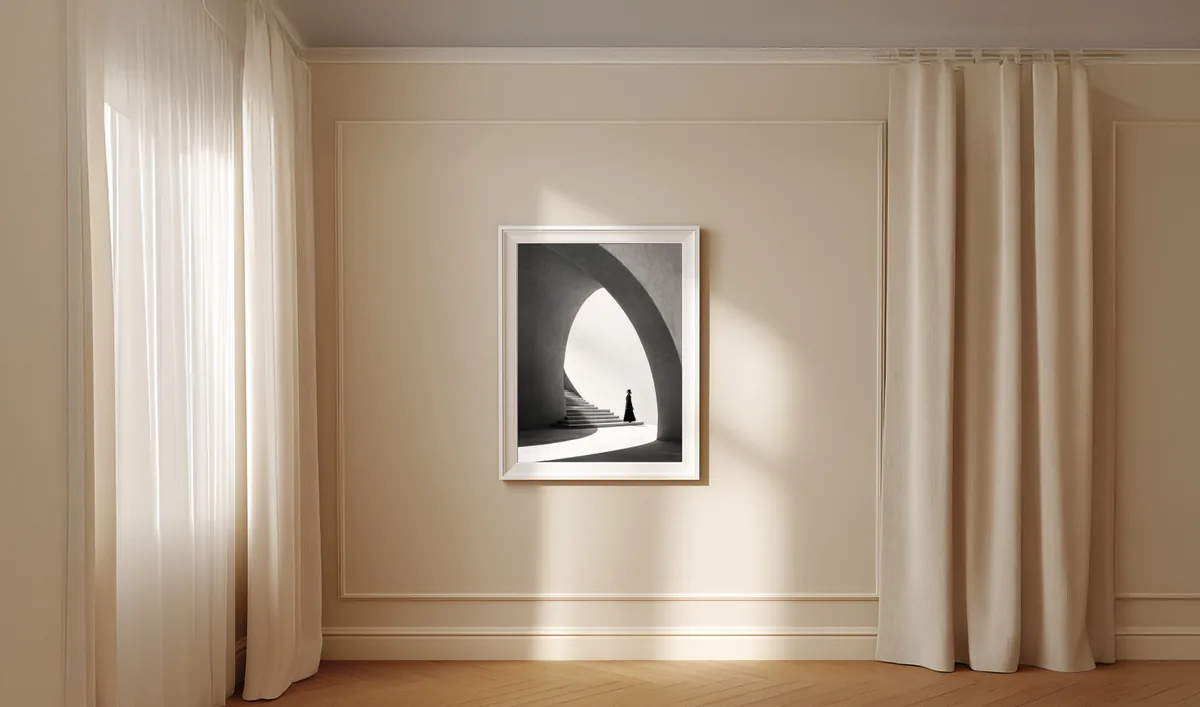
01
The saloon
The artwork changes with the charter, the guests or the crossing. It is hung on the existing fixing, and nothing behind the panelling was touched to make it possible.

Spaces / Yachting and aviation
The problem
On board, every cable is a project. Running one means opening a headliner or a bulkhead, involving the yard, and accepting a schedule measured in weeks. Every watt is counted against a finite supply. And every lit surface argues with an interior where the joinery, the leather and the light were specified to the millimetre. The usual answer is to install nothing at all, and to live with fixed artwork for the life of the vessel.
Three moments
01
The artwork changes with the charter, the guests or the crossing. It is hung on the existing fixing, and nothing behind the panelling was touched to make it possible.
02
A private selection, changed between trips. The frame reads as a framed print, because at rest that is exactly what it is.
03
A private terminal holds its identity without a lit panel, on a wall where no electrical supply was ever planned.
What Studio orchestrates here
The object is only half of it. What makes it usable at scale is being able to decide, once, what appears where and when.
What changes
No infrastructure, no refit, no headliner to open. The object arrives finished and is hung like a picture, which removes the yard from the equation entirely and turns a multi-week works item into an afternoon.
This is the environment that proves the principle. If a surface can work with no cable, no network and no measurable power draw here, it can work anywhere.