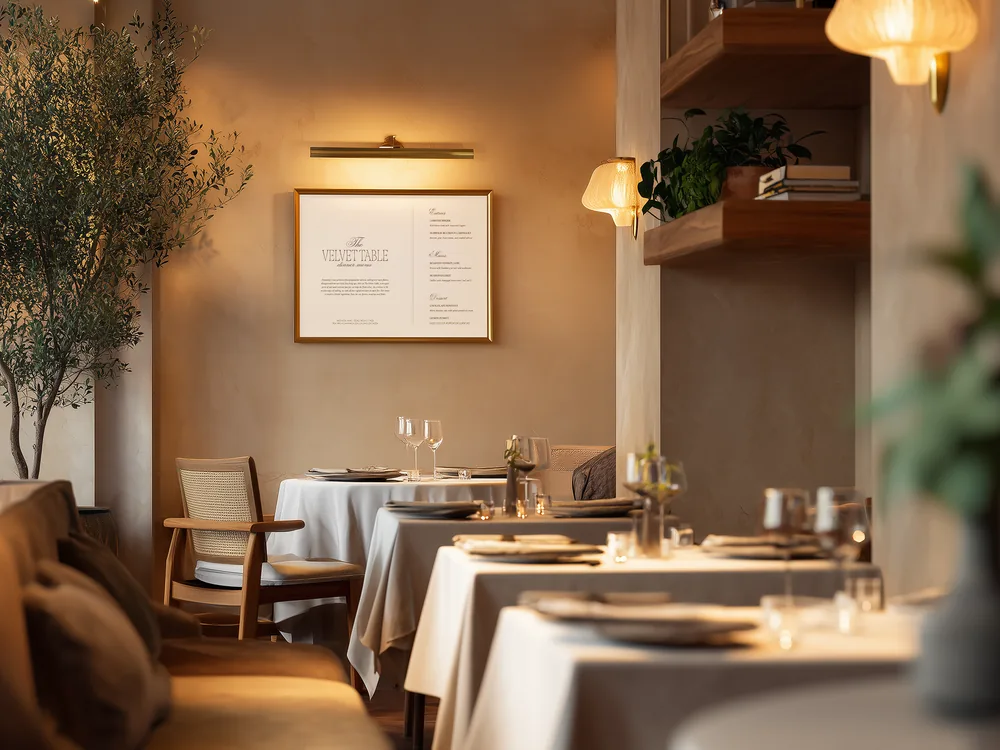
01
The card at the entrance
The menu is set in the morning and corrected at eight when a dish goes. What a passer-by reads is what the kitchen can actually serve.

Spaces / Dining
The problem
The lit menu board belongs to fast food, and every restaurateur above that level knows it. So the menu goes back to paper, and paper means reprinting at every change: a supplier who did not deliver, a dish that sold out at eight, a vintage that ran out last week. The card on the wall is out of date more often than it is correct, and the one at the entrance is the first thing a passer-by reads.
Three moments
01
The menu is set in the morning and corrected at eight when a dish goes. What a passer-by reads is what the kitchen can actually serve.
02
A vintage runs out and it leaves the list the same evening, without a reprint and without a pen stroke through a line.
03
Lunch service ends and the wall becomes the cocktail card. The room changes register without anyone carrying a board out of a cupboard.
What Studio orchestrates here
The object is only half of it. What makes it usable at scale is being able to decide, once, what appears where and when.
What changes
Daily reprinting disappears, and so does the obsolete menu. For a group running several venues, the same discipline applies everywhere without depending on who is on shift that evening.
The test is simple. At two metres, a guest should read a card, not a device. That is the only reason ePaper belongs on this wall and an emissive panel does not.